27.05.2026

The debate about whether New Zealand is experiencing a brain drain is back in the headlines in 2026.
Yet while eye-catching, the narrative of the brain drain simplifies New Zealand’s migration flows and provides only part of the picture.
The current debate largely focuses on departures while ignoring citizen returns and immigration. In a world where people can and will move for better opportunities and lifestyle, this matters.
Yes, departures are up
The departure of New Zealand citizens has surged since the COVID-19 pandemic. Annual citizen departures more than doubled between 2021 and 2025 from 26,000 to 64,000.
At the same time, New Zealand has also seen an increase in youth mobility. Between 2021 and 2025, the share of those departing New Zealand who were aged 20-34 rose from 41% to 43%.
However, departure numbers from just the past five years alone do not tell the full story. What appears on the surface as an unprecedented outflow of Kiwis may not be: we need to look at history.
Cycles and culture matter
Emigration is not a new phenomenon in New Zealand. Since the 1970s, the country has experienced cyclical emigration shaped by changing social and economic conditions, as well as growing global mobility.
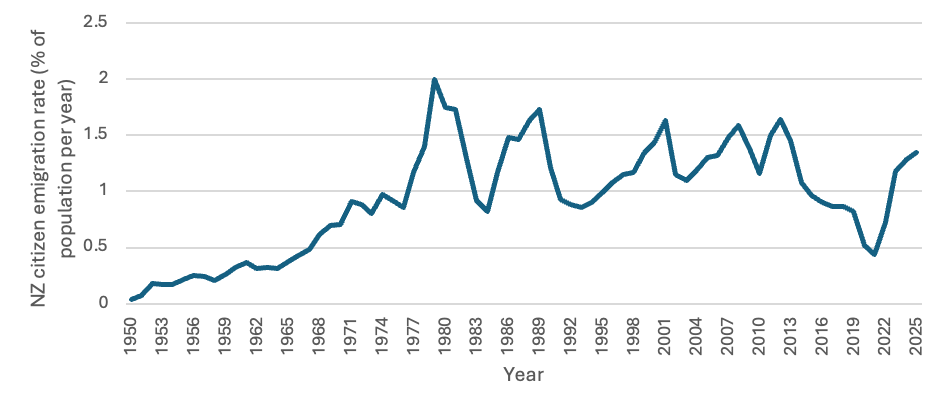
(Data source: Stats NZ 2025. Inspired by Charted Daily)
Youth mobility is also not new, nor is it necessarily a bad thing. Many New Zealanders do an ‘OE’ before settling down in New Zealand, a pattern of long-term temporary rather than permanent emigration. The recent increase in youth mobility may be an indication of a return to pre-COVID-19 norms, where youth represented, on average, 46% of departures.
Yet the narrative of the brain drain naturally draws our attention to who is leaving but leaves out the question of who is arriving. This question matters. If New Zealand cannot give its people good opportunities, they may never come back.
We’re ignoring part of the story
Even if our emigration is cyclical and youth mobility is cultural, the widening gap between arrivals and departures paints an uncertain picture about return migration. Citizen arrivals have declined from a post-2001 peak of roughly 41,000 a year in 2019 to roughly 27,000 a year in 2025.
It is hard to know whether recent trends in arrivals and departures point to a temporary lag or a real structural shift in migration. A temporary lag could simply reflect delayed returns after COVID-19. A structural shift would imply that New Zealanders are systematically staying away longer or are less likely to return at all. This would be a real problem and raises questions about the ability of the country to keep its young, often skilled citizens.
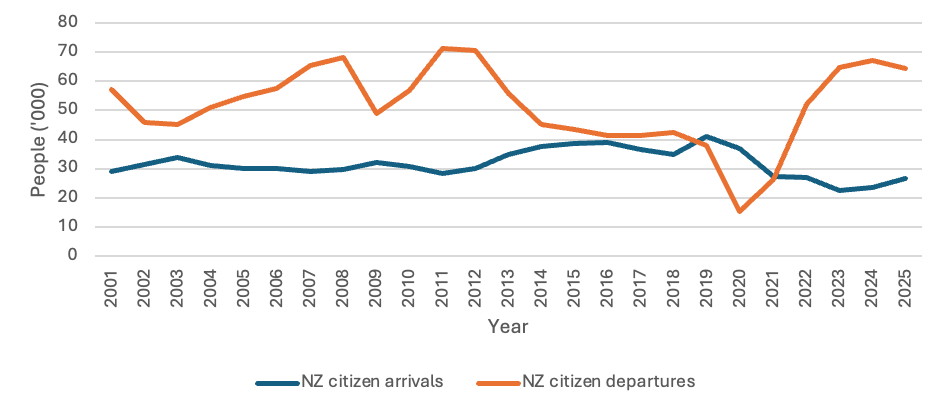
(Data source: Stats NZ 2026)
All of this also ignores the role of immigration in our migration story. New Zealand has long been a desirable destination country for immigrants who bring with them skills, education and talent. New Zealand is recognised as having one of the most skilled immigrant populations of any OECD country. Yet in the growing global competition for skilled migrants, New Zealand may struggle to continue to attract talent.
So what?
Population trends are important to reflect on. Yet the catchy label of a brain drain does a disservice to the complexity of our emigration and immigration flows.
Selective analysis, the lack of good quality data, and simplistic narratives limit our understanding of recent trends. A more constructive approach is needed with better data on who is leaving and why if we are to fully understand our migration patterns and emigrating population.
Rather than whether we are experiencing a sudden brain drain crisis, the real questions to address may be: how do we make New Zealand an attractive place to live and work, and how can we entice New Zealanders abroad, as well as other offshore talent, to settle back in New Zealand?
Data source:
All data sourced from Stats NZ. (2025). Net migration gain of 13,700 and Stats NZ. (2026). International migration: January 2026