18.06.2026

Recent times have seen social cohesion return to the foreground of New Zealand policy debate. Indeed, social cohesion is an asset that informs how societies respond under pressure.
Yet in a world of new, cascading crises in which our social contract is coming apart, social cohesion must be contextualised.
New Zealand needs a new organising framework to think about national preparedness and democratic stability.
Enter societal resilience.
Our social contract is fraying in an age of interconnected disruption
The past decade has been defined by new kinds of pressures. The global information environment has fractured our shared sense of reality, weakening the kind of common ground needed for democratic societies.
At the same time, disruptions no longer occur in isolation. Pandemic recovery, geopolitical instability, climate-related extremes, rapid technological acceleration, and weakening trust in institutions overlap, reinforce one another and place increasing strain on society.
The social contract underpinning liberal democracies like New Zealand is also under pressure. The long-held belief that hard work should deliver fair opportunities feels increasingly uncertain for many.
Few countries, including New Zealand, are prepared for this kind of “poly-crisis.” Our ill-prepared response to Cyclone Gabrielle in 2023 is but one example of how quickly the country can become overwhelmed by interconnected pressures.
Reorienting social cohesion
New Zealand is increasingly turning to social cohesion as we look for a way to move forward in turbulent times. Our renewed attention reflects a broader and necessary recognition that societies and their people are more than mere human capital.
Indeed, social cohesion is an essential part of society. Trust, belonging and institutional legitimacy matter for a strong democratic society.
Koi Tū has positioned social cohesion at the heart of its work since 2019 for this reason. The study and measurement of social cohesion remains important, and we must continue these efforts.
Yet social cohesion is not the only element of a resilient society. High levels of interpersonal trust do not automatically translate into the capacity to manage geopolitical shocks, climate events, technological disruption or supply chain failures.
Moreover, in the context of cost-of-living pressures and rising inequality, we cannot expect individuals to remain resilient in failing systems.
Societal resilience helps us see the whole system
Societal resilience offers a framework to contextualise social cohesion alongside other factors that create a resilient society and position the individual within a wider system.
Societal resilience is a society’s collective capacity to absorb, recover from and adapt to both short-term shocks and long-term stressors.
A society’s resilience emerges from a range of interacting domains, from the environmental all the way to the information environment.
Social cohesion is undoubtedly a factor here, expressed through resilience’s social and institutional components, but it is not the only one.
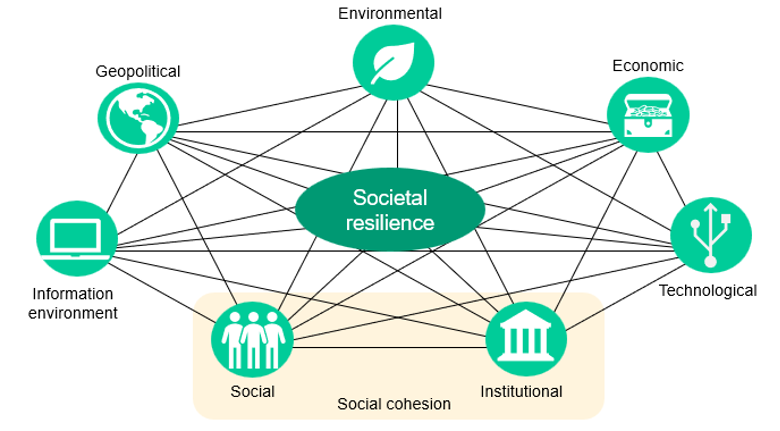
More importantly: A societal resilience lens invites systems-level thinking. In an environment of siloed policy-thinking, it invites policymakers to consider answers to challenges that do not neatly fit within traditional policy boundaries and departmental silos.
The next pandemic’s impacts will not play out in our health system alone. Our economy, information environment and social systems will all be affected. An integrated response, viewed through a resilience lens, will be critical to sustaining our democracy.
What next?
New Zealand policymakers should position societal resilience as a part of an ongoing policy agenda. Already, there is clear international momentum behind this shift.
Moreover, societal resilience, like social cohesion, must be treated as an asset that can help our society respond to turbulent times. More work is needed to understand its domains and their interactions to inform meaningful policy.
In a world of new shocks, enduring stressors and interrelated disruption, societal resilience may be the key to maintaining a democratic society.