01.05.2026

New Zealand has reached a number of tipping points in terms of population change. How we respond will determine our future prosperity.
Within a generation, our population will be much older and much more diverse, with slowing population growth as fertility rates decline.
If we are to navigate these shifts, New Zealand urgently needs a long-term and bipartisan population strategy. Yet policy responses to demographic change remain fragmented, politically charged and short-term.
New Zealand’s demographic future
New Zealand’s demography is shaped by several major trends, each with critical implications for the way we live our lives.
New Zealand’s fertility rate (the average number of children born to a woman) has already fallen to 1.55. This number is likely to continue to fall. A fertility rate of 2.1 is needed to maintain the current population size.
New Zealand’s population is also rapidly ageing. By 2048, nearly 25% of the population will be over the age of 65.
It is great that New Zealanders are living longer, healthier lives. Yet an ageing population places increasing pressure on government spending, healthcare and superannuation (the cost of which is expected to rise from 5.1% to 8% of GDP by 2065).
As fewer people are born and more exit the workforce as they age, New Zealand will struggle to maintain its workforce. Business NZ predicts that by 2045, New Zealand will face a labour shortage of 250,000 people. New Zealand’s economy will struggle under the weight of talent and skill shortages.
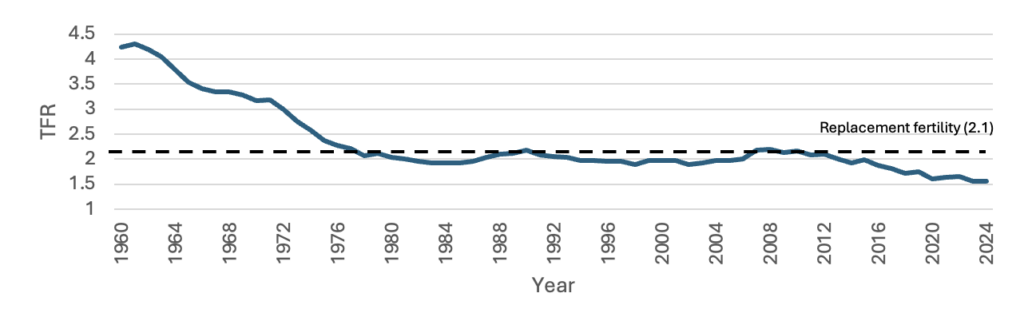
(Data: Wikimedia commons)
With falling fertility and an ageing population, immigration will become even more critical to growing both our workforce and population. Yet immigration numbers have been volatile over the past decade. We have also seen a significant spike in the departure of New Zealand citizens since 2022.
Immigrants play a crucial role in making up for shortfalls in our talent and labour pool, particularly in sectors such as medicine, teaching and technology. Yet as offshore competition for talent grows (as other countries face similar demographic headwinds), New Zealand may struggle to attract and retain the skilled people we desperately need.
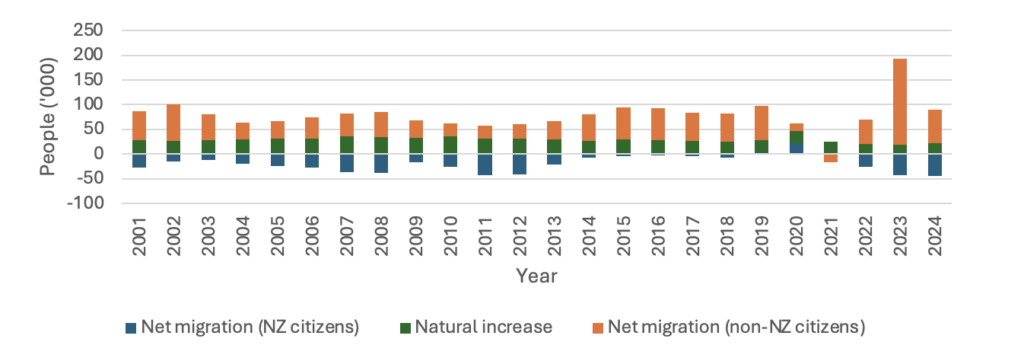
(Data: Stats NZ)
Finally, ethnic diversity is rising rapidly. By 2048, those identifying as European-Pākehā will have declined while all other ethnicities will have grown. Those who identify as Asian will make up a third of the population. Māori more than 20%.
Growing diversity presents opportunities for innovation, creativity and diversity of thought. However, certain barriers remain. If New Zealand is to harness its diversity, it needs to invest in social cohesion.
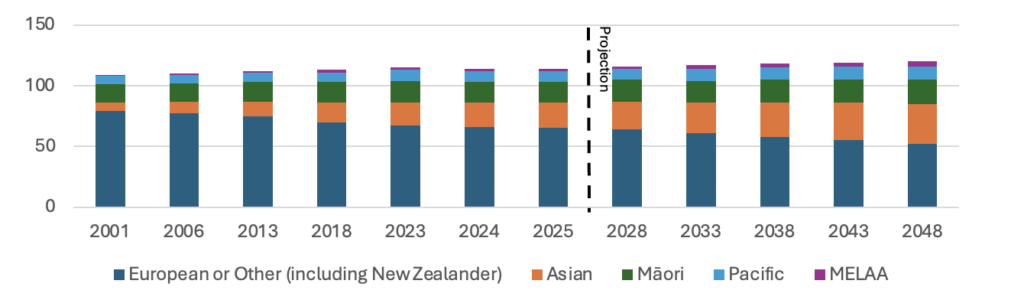
(Data: Stats NZ)
New Zealand’s response has been inadequate so far
New Zealand’s demographic trends present both opportunities and challenges to our future prosperity.
Unfortunately, many policies related to demographic change are politically fraught. Few mainstream politicians wish to expend political capital on divisive topics like superannuation and immigration.
New Zealand also falls victim to a short-term policy horizon. Political parties are incentivised to prioritise short-term wins rather than to consider long-term policy. It is, after all, harder to sell an idea when the benefits will not be seen for decades to come.
Demographic change is complex and requires long-term solutions backed by evidence. Yet our current political system is not set up for this.
The case for a population strategy
At such a significant demographic inflection point, New Zealand needs a coherent, long-term and bipartisan plan to manage the implications of our demographic change.
Enter a population strategy.
A population strategy would ensure a sustained, intergenerational response to demographic change.
A population strategy would remove important yet difficult topics like immigration and superannuation from a politically charged environment, elevate planning beyond a three-year election cycle and counter siloed responses.
New Zealand now faces a pivotal decision regarding our demographic trajectory. The evidence suggests we cannot take a ‘she’ll be right’ approach. The stakes are too high and our current trajectory risks under-delivering on future prosperity.
A population strategy is no longer a ‘nice to have’; it has become essential.
| New Zealand needs a long-term and non-partisan population strategy to prepare for major demographic shifts. People, place and prosperity: The case for a population strategy is authored by Koi Tū Fellow Georgia Lala, Senior Fellow Distinguished Professor Emeritus Paul Spoonley and Director Sir Peter Gluckman. It arguesthat New Zealand’s rapidly changing demographic make-up has reached a critical point. Read the report: informedfutures.org/population |