29.07.2026

New Zealand’s short electoral cycle and political culture make sustained, long-term policymaking difficult. Nowhere is the cost more apparent than in our persistently weak productivity performance. This essay focuses on one essential – but not sufficient – part of the response: sustained public investment in science and research.
The graph pictured below appeared in the second report of the Science System Advisory Group, which one of us (Peter Gluckman) chaired for the current administration.[1] It should prompt politicians and policymakers, irrespective of ideology, to rethink.
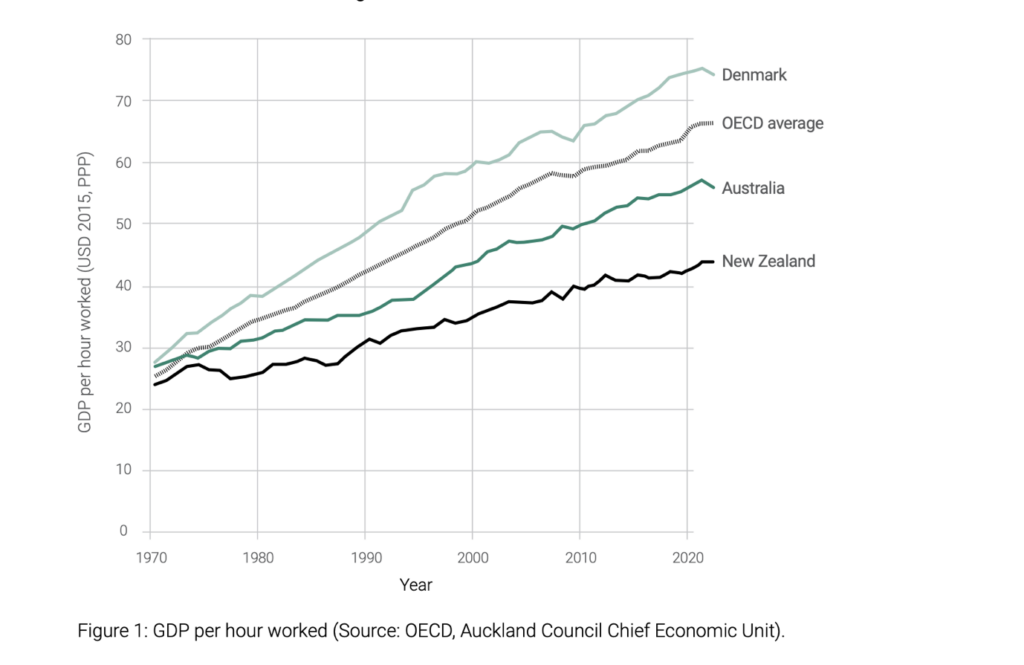
Based on OECD data, the graph reveals a profound and persistent weakness in the New Zealand economy. Its message is both clear and alarming: for more than half a century, New Zealand has recorded unusually slow productivity growth.
Since the 1970s, our performance has steadily diverged from Australia and other OECD countries. Denmark provides a particularly revealing comparison. In 1970, it was a small, agriculture-dominated economy with productivity similar to ours; today, the gap is stark. The measure shown – GDP per hour worked – adjusts for population growth and differences in hours worked.
Across roughly 15 electoral cycles, regardless of the parties in office, New Zealand’s economic performance has disappointed. The reforms of the 1980s may have lifted the trajectory from near stagnation to modest growth, but they were not enough to prevent further divergence from comparator countries.
For the past 35 years, our approach has remained incremental, even as we have sought to sustain an extensive social safety net that depends on a productive economy. Neither the Christchurch earthquakes nor the pandemic explains the pattern; the divergence was firmly established before either. We now face a world increasingly shaped by technology, intense competition for talent, and an ageing population.
Why, then, has New Zealand underperformed so persistently, and what should we do now?
The move to a freer-market economy in the 1980s was necessary to improve competition, openness, and market incentives. It altered the trajectory, but it was not sufficient. Sustained productivity growth also depends on knowledge creation, technology diffusion, skills, capital deepening, and institutional capability. The cost of neglecting these foundations is now becoming painfully clear in a world where talent is mobile and science- and technology-based innovation increasingly shapes economic futures. An adequate public science investment is not, by itself, a productivity strategy; rather it is one essential component of the broader, sustained effort New Zealand needs to increase its productive capacity.
We failed to recognise that, although agriculture could – and did – support us to a point, it could not by itself sustain an advanced economy in a globalised world. As globalisation accelerated in the 1980s and 1990s, other small countries understood that an economy built on agriculture and domestically focused, low-value manufacturing would not be enough. Low-value manufacturing would inevitably struggle against production in lower-wage economies, particularly in a small domestic market lacking scale. These countries moved deliberately towards high-value, knowledge-intensive production, investing in advanced manufacturing, research and development, and STEM education. Over subsequent decades, those investments paid off.
Many aligned public research investments with areas of potential comparative advantage. Denmark’s investment in biotechnology is one example. Where public science funding grew, alongside openness to foreign investment and international talent, private investment followed and innovation economies expanded.
New Zealand took a different path. We maintained only modest public investment in R&D: enough to assist the pastoral sector, where Treasury’s own analysis has found substantial and persistent returns, but not enough to transform the wider economy. Public R&D investment has remained around 0.5–0.6% of GDP. It is naïve, and in contrast to other nations’ experiences, to imagine sustained economic growth from private sector investment without a broadly-based public research sector.[2] The science system review highlighted how public sector activity fuels private sector activity, not displaces it.
The Government’s Science Investment Plan 2026–2036[3] continues at roughly 0.6% of GDP, with no suggestion of future increases (and potentially a decline) despite comparative evidence suggesting that public research investment closer to 0.8–1.0% may be needed to shift our productivity trajectory. The current redesign of the science system is necessary, but without additional investment it cannot fulfil its potential. Geography compounds the challenge: New Zealand remains distant from major markets and often positioned at the end of global value chains. Unless we move towards a higher-value, innovation-based economy, that position will become increasingly costly.
Agricultural productivity itself is becoming increasingly knowledge intensive. Genomics, precision agriculture, AI, robotics, sensing, automation, and advanced biotechnologies will shape the future competitiveness of food production. Major breakthroughs may pass us by if we continue to defer investment: science takes time to generate returns. Climate change, environmental pressures, biosecurity threats, and competition from science-savvy nations will reshape the pastoral sector. For decades, world-leading agricultural productivity has underpinned national prosperity. Yet there is a limit to what primary production can sustain without a stronger scientific base. If New Zealand underinvests in research – or regulates itself out of frontier technologies – we risk weakening the very sector that has historically protected us.
The wider challenge is even greater. AI, quantum technologies, and the life sciences are reshaping economic security and growth. New Zealand is behind the curve in each, despite recent commitments that remain small by international standards and have largely involved reallocating existing funding rather than adding new investment. Regulatory settings that prevent the responsible use of advanced life-sciences technologies will compromise agriculture’s ability to continue providing a floor beneath our economic performance.
This is not a partisan issue. Every political party should explain either how it will shift the productivity curve or how it will prepare citizens for a very different economic future. Advanced economies require advanced human and physical R&D infrastructure; none has built it without substantial public investment to prime the system. The table below comes from the Science System Advisory Group’s first report, An architecture for the future.[4] It shows that New Zealand’s total R&D investment –public and private – is around half the OECD average and well below that of many comparable countries.
Private-sector R&D has grown, and New Zealand has stellar firms such as Rocket Lab and Halter. But it is unrealistic to remain passive and rely on luck. No country has built a successful innovation economy by repeatedly delaying public investment in R&D.
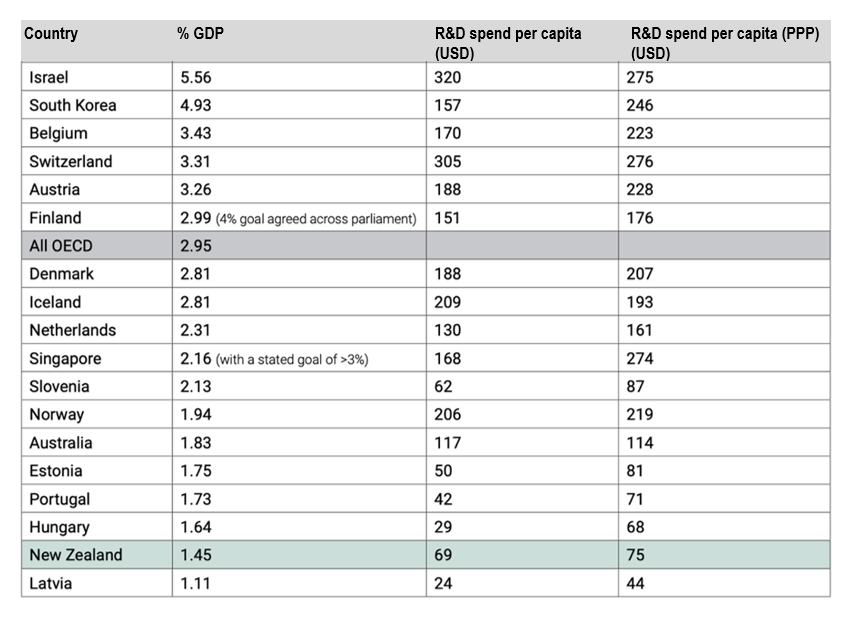
Total non-defense R&D spend expressed as %GDP by country, and then expressed as R&D spend per capita in USD and purchasing power parity (PPP) power per capita in nominal USD from World Bank data, Feb 2025
The political difficulty is that R&D investment rarely wins immediate votes, while its returns take years to emerge. Some Treasury voices have argued that the causation runs the other way – that rich countries can afford R&D, rather than R&D helping countries become rich. The international evidence strongly supports a two-way relationship: prosperity enables investment, but sustained research and innovation also drive productivity and growth. The returns are not only economic; they are social and environmental as well. Successful countries may orient their R&D systems towards innovation, as New Zealand is now attempting, but not at the expense of the wider foundations of a research- and knowledge-based society.
New Zealand’s productivity challenge is not only to generate frontier innovations, as Rocket Lab, Halter, and Apple’s Auckland Technology Centre have shown. It is also to adopt and spread technologies developed elsewhere. Too often, these successes do not ripple through ordinary firms. Diffusion depends on management capability, owner ambition, capital investment, workforce skills, firm scale, competition, international connectedness, and institutions that support risk-taking, knowledge-sharing, adoption, and adaptation. The deeper policy question is: why do frontier technologies fail to spread more widely through our economy? Other small countries, where entrepreneurship and risk-taking are more deeply embedded, show that scale is not an excuse.
Our argument is not that a greater and adequate public science investment will solve New Zealand’s productivity problem on its own, but that no credible strategy for a more productive and future-focused economy can succeed without it.
New Zealand’s three-year political cycle inevitably encourages incremental positioning; little in our system rewards long-term thinking. Since its inception, Koi Tū has argued for a longer view. Short-termism is understandable, but it will not lead us out of a disappointing trajectory. There is a limit to what can be achieved within current policy framings.
At a recent meeting, the chief executive of a major company posed the fundamental question about New Zealand’s future and the role of research and innovation: “Are we going to remain a small, advanced economy, or are we heading towards becoming a small, non-advanced economy?” It is a question on which we should all reflect.
[1] Science System Advisory Group. (2025). A pathway to the future: New Zealand’s science and innovation system. Ministry of Business, Innovation and Employment. https://www.mbie.govt.nz/assets/Science-system-advisory-group-report-a-pathway-to-the-future-new-zealands-science-and-innovation-system-proactiverelease.pdf
[2] A thriving public research sector has other critical roles beyond direct impacts on economic growth in supporting public policy and stewardship of a nation’s assets. See Gluckman, P. & Sridhar, H. (2024) Framing public research investments for the policy community. https://policylabs.frontiersin.org/content/commentary-framing-public-research-investment-decisions-for-the-policy-community
[3] Ministry of Business, Innovation and Employment. (2026). Science investment plan 2026–2036. https://www.mbie.govt.nz/dmsdocument/32023-science-investment-plan-2026-2036
[4] Science System Advisory Group. (2024). An architecture for the future. Ministry of Business, Innovation and Employment. https://www.mbie.govt.nz/assets/science-system-advisory-group-report.pdf